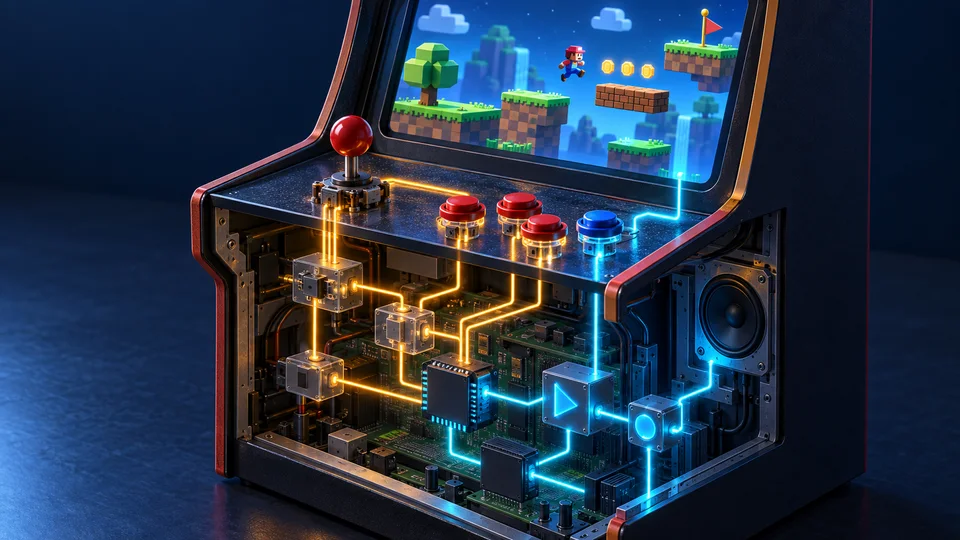
Somewhere on the internet there is a video of somebody demonstrating a calculator. Nothing remarkable in that, except the calculator has been assembled inside a video game out of switches, wires and moving blocks, and it takes about ninety seconds to add two numbers that a pocket device would handle instantly. The comments are full of people asking why anyone would bother. The answer is more interesting than the machine.
Everything useful reduces to a switch
Start with the historical claim, because it grounds the rest. Before the 1930s, electrical circuit design was largely a craft of accumulated tricks. What turned it into a discipline was the recognition that the algebra George Boole had developed for reasoning about true and false statements described exactly what networks of on-off relays do. Boole's true and false map onto a relay's closed and open, and the operations of that algebra map onto arrangements of relays in series and parallel.
Practical demonstrations followed quickly. The Computer History Museum's record of 1937 notes George Stibitz building a relay-based adder at home from spare parts, a modest device that showed Boolean logic could be applied directly to the design of computing machinery. Everything downstream, from wartime calculators to the processor you are reading this on, is an elaboration of that idea with faster switches.
The consequence that matters here is one of substrate independence. The algebra does not care what the switch is made of. Relays worked. Vacuum tubes worked. Transistors work. Water valves work, and people have built working adders out of plumbing. If a game gives you components that can be reliably on or off, and a way for one component's state to control another's, you have the raw material for computation whether the designers intended it or not.
Building a gate out of a game
Three operations are enough. NOT flips a signal: given power in, it gives nothing out, and given nothing in, it gives power out. AND emits a signal only when both of its inputs are present. OR emits a signal when either one is. Every logical expression can be built from these, and in fact you can build all three from repeated use of a single operation, NAND, which is why chip designers often think in terms of one universal gate rather than a family.
In a sandbox game, each of these becomes a physical arrangement. AND is usually the easiest: put two switches in series along a wire so that current only reaches the far end when both are thrown. OR is two paths converging on the same destination. NOT is the fiddly one, because it needs a component that is powered by default and suppressed by input, which most games provide in the form of an inverting element or a mechanism that blocks a signal when activated.
From there it is straightforward, if laborious. Combine gates into a half adder, which produces a sum and a carry bit from two inputs. Chain half adders into a full adder. Line up eight full adders and you can add two eight-bit numbers, which is enough for a calculator that counts to 255. Every one of these steps is standard undergraduate material, and the free curriculum at Nand to Tetris walks through precisely this progression from a single gate up to a working computer, which is why so many players who have never taken an electronics course nevertheless recognise what they are doing.
Clocks, memory, and the awkward business of time
Gates alone give you a machine that reacts instantly and remembers nothing. Real computation needs two more ingredients, and both involve time.
The first is a clock: a component that alternates between on and off at a steady rate, giving the rest of the machine a shared heartbeat. In games this is typically a loop that feeds its own output back into its input through a delay, so it oscillates. Builders spend a surprising amount of effort tuning clock speed, because a circuit that runs faster than its slowest component can settle produces nonsense.
The second is memory. Feed the output of a gate back into its own input in the right arrangement and you get a circuit with two stable states that will sit in whichever one it was last pushed into. That is a latch, the ancestor of every register and every cell of static memory. It is the moment a pile of wire stops being a reflex and starts being something that can hold a fact. Everything a computer does with variables descends from that loop.
The reason in-game builds get physically enormous is that these components are spatial. A processor squeezes billions of switches into a fingernail; a game gives you switches the size of a crate, and the wires between them take real seconds to carry a signal. A machine that would be invisible in silicon becomes a structure you walk around inside, which is exactly what makes it a teaching object.
Why it keeps happening
The tendency is not confined to sandbox construction games, which is the surprising part. Computation turns up wherever a rule system is rich enough. Cellular automata are the classic example: simple grids where each cell's next state depends on its neighbours, catalogued in detail at Wolfram MathWorld. Conway's Game of Life, with four short rules and no notion of wires at all, is capable of universal computation, and Paul Rendell has documented a working Turing machine built inside it.
Tabletop games are not exempt either. A paper by Alex Churchill, Stella Biderman and Austin Herrick argues that Magic: The Gathering is Turing complete, constructing a machine out of legal card interactions in a game whose designers were assuredly not thinking about computability. Their conclusion is that determining the outcome of a legal position in that game is not, in general, decidable.
What connects these cases is that computation is a low bar, not a high one. It does not require anyone to intend it. Any system offering conditional behaviour, some form of state that persists, and enough space to arrange things in will support it accidentally, and rule sets rich enough to be interesting are usually rich enough to be computational.
What you actually learn
The educational payoff is not that you can now build an adder. It is the loss of a certain mystique. Having wired an AND gate out of blocks, watched a latch remember a bit, and timed a clock badly enough to corrupt your own output, you cannot easily go back to thinking of a processor as inscrutable. It is the same arrangement, made from smaller switches, repeated an obscene number of times, and running so fast the intermediate states become invisible.
That is a genuinely useful thing to know, and games teach it by accident, in the middle of an afternoon that was supposed to be about something else. The calculator is slow and pointless. The understanding is neither.