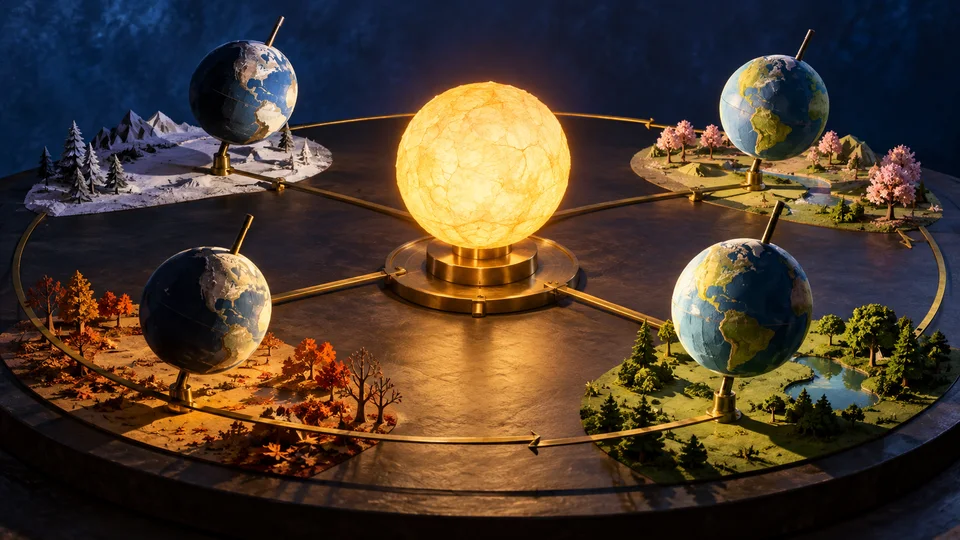
Ask when summer begins and you will get an argument. One person will say the solstice in late June. Another will say the first of June, and will be equally certain. Both are quoting a real convention, and neither is describing anything the sky actually does, because the sky does not do boundaries. It does a gradual, continuous change of angle, and the lines across it are ours.
Two calendars, two answers
The astronomical seasons are pinned to the solstices and equinoxes, the four moments defined by the geometry of Earth's orbit and tilt. Northern spring starts at the March equinox, summer at the June solstice, and so on. Because the orbit is elliptical and Earth moves at different speeds along it, these seasons are not equal in length, and the dates shift by a day or so from year to year.
The meteorological seasons ignore all of that and use whole calendar months. In the northern hemisphere, spring is March to May, summer June to August, autumn September to November, winter December to February. The reasoning is entirely practical: as the US National Centers for Environmental Information explains, blocks of three whole months make it far easier to compare statistics across years, since the astronomical seasons wander in both start date and length. If you want to compare this summer's rainfall with the one forty years ago, you want the same number of days in each.
So the two answers serve different masters. One is a fact about orbital geometry. The other is a filing convention that happens to line up better with when it actually feels warm, since the warmest months in much of the northern hemisphere are June to August rather than the three that follow the solstice.
That mismatch has its own name. Ground and especially ocean take time to warm and time to give the heat back, so the hottest part of the year arrives weeks after the peak of incoming sunlight, and the coldest part weeks after the minimum. The delay is called seasonal lag, and it is why the longest day rarely feels like the middle of summer even though, in the astronomical scheme, that is exactly what it is meant to be. Any calendar that pins summer to the solstice is describing the light rather than the weather.
Tilt, not distance
The other reliable confusion is about cause. It seems obvious that summer is when we are closer to the Sun. It is also wrong, and the evidence is sitting in the calendar.
Earth reaches perihelion, its closest approach to the Sun, in early January, and aphelion, its furthest, in early July. The difference is around five million kilometres, which is not nothing but is small against an average distance of about 150 million. If distance drove the seasons, January would be the warm month across the whole planet. It is not, and the southern hemisphere is having summer at the same time the northern hemisphere has winter, which no distance-based account can explain at all.
The actual mechanism is the tilt of the axis, roughly 23.5 degrees away from the perpendicular to the orbit, and the fact that this tilt keeps pointing the same way as Earth goes round. NASA's explanation of the seasons lays out the consequence: when your hemisphere leans towards the Sun, sunlight strikes at a steeper angle and the same amount of energy lands on a smaller patch of ground, and the days are longer, so more of it arrives. Lean away and the same energy is smeared across more surface and delivered for fewer hours. Angle and duration, not proximity.
Seventy-two seasons
Four seasons is a choice, not a discovery, and other calendars have made different ones. The traditional East Asian calendar divides the solar year into twenty-four segments, known in Japan as sekki, each about a fortnight long, running from Risshun, the beginning of spring in early February, through to Daikan, greater cold. These are not weather forecasts; they are positions of the Sun along the ecliptic, each with a name describing what the year is doing.
Japan then subdivides each of those into three, producing seventy-two kō of roughly five days each. Their names are extraordinarily specific: east wind melts the ice, bush warblers start singing, the first peach blossoms, rotten grass becomes fireflies. The set was originally imported from China but did not match conditions on the archipelago, and it was rewritten in 1685 by the court astronomer Shibukawa Shunkai so that the descriptions matched what people could actually see out of the window. Nippon.com maintains readable guides to both the twenty-four solar terms and the seventy-two microseasons.
Five days is short enough that the calendar stops being a schedule and becomes an instruction to pay attention. You cannot use a season called first peach blossoms without going to look at a peach tree.
Eight seasons and a reindeer year
Further north, the Sámi peoples of northern Norway, Sweden, Finland and the Kola Peninsula traditionally count eight seasons rather than four. The familiar winter, spring, summer and autumn are separated by four transitional ones, so the year runs through something like winter, spring-winter, spring, spring-summer, summer, autumn-summer, autumn and autumn-winter.
The divisions are not decorative. They are organised around what reindeer are doing and what the herding year therefore requires: migration, calving, the summer in the mountains, the autumn separation and slaughter, the return to winter pasture. WWF's Arctic programme has published an account of the herding year that follows this cycle. In a landscape where the meaningful changes are about snow conditions and animal behaviour rather than a rough sense of warm and cold, four labels are simply too blunt to be useful, and eight are earned.
What the boundary is for
Set these systems side by side and the pattern is clear enough. Every seasonal calendar is a compromise between the astronomy, which is smooth, and whatever its users need to keep track of. Meteorologists want tidy statistics. Japanese court astronomers wanted an accurate poetic register of the year. Reindeer herders want to know when to move. Four seasons is what you get if you split the difference and do not need much precision.
Whether the boundaries track anything in how people feel from month to month is a genuinely contested question in the research literature, and we are not going to pretend the matter is settled. What is not contested is that the lines are conventions. Nothing snaps on the first of June, and nothing snaps at the solstice either. There is only the angle of the light, changing every single day, and a set of names we have agreed to hang on it so that we notice.