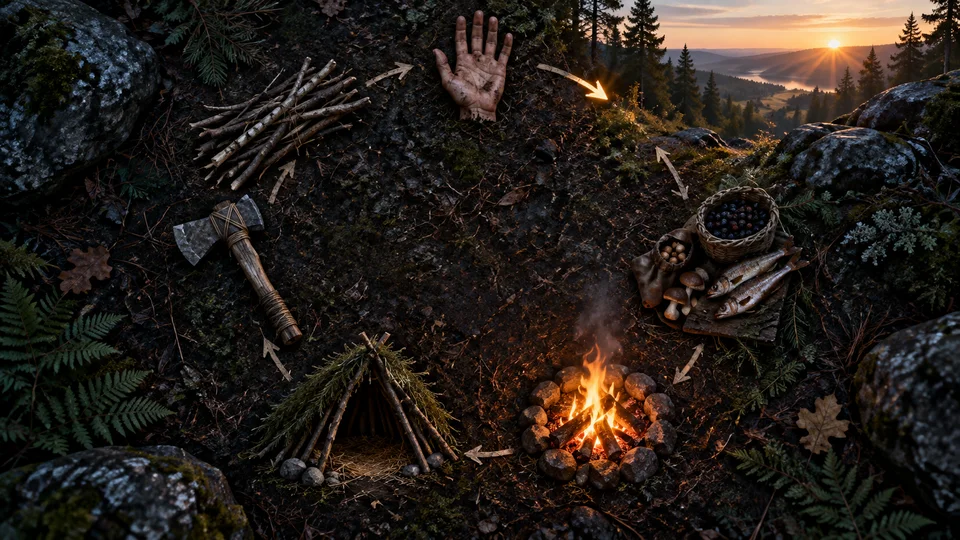
The first night in a survival game is almost always the best night. You have nothing, it is getting dark, and every decision is urgent and legible. Wood or stone first. Shelter or light. By the fortieth hour you have automated food, fortified a base and mastered the systems, and something has quietly gone out of it. Understanding why that curve bends the way it does explains a great deal about how the genre is built.
Scarcity is the design material
Survival design begins by taking things away. Hunger, temperature, durability and darkness are not obstacles bolted on for realism; they are the mechanism that converts an open world into a sequence of decisions. Without pressure, an open world is a diorama, and the player has to invent their own reasons to move. Add a depleting resource and every minute acquires an opportunity cost.
Scarcity also does a quiet tutorial job. It sequences your learning without a single instruction. You learn about food because you are hungry, about shelter because night is coming, about tools because your hands are slow. Nothing has been explained, and yet the order in which you encounter systems is tightly controlled by which need becomes acute first. This is why so many survival games feel harder to explain than they are to play.
The catch is that scarcity is self-liquidating. Solve hunger permanently and the mechanic stops generating decisions; it becomes a chore with no tension, an occasional trip to a stockpile. Designers respond by introducing new scarcities at higher tiers, which works for a while and eventually runs out of ideas. The decay of the first-night feeling is not a flaw in any particular game so much as an inevitable consequence of getting good at it.
The day-night cycle deserves particular credit here, because it does something no resource meter manages. It imposes a rhythm nobody chose, arriving on schedule whether or not you are ready, and it turns an otherwise shapeless session into acts with intervals between them. Night is a deadline you cannot negotiate with, and deadlines are extraordinarily good at making people decide. Games that soften the cycle to reduce frustration frequently discover they have removed the structure that made the early hours memorable.
The pull of a nearly finished goal
There is a well-studied reason why the last few items in a crafting recipe feel more compelling than the first few. Early behavioural research described a goal gradient: effort intensifies as a reward gets closer. The finding was revisited in a human, commercial context by Ran Kivetz, Oleg Urminsky and Yuhuang Zheng, whose 2006 study in the Journal of Marketing Research tracked customers in coffee-shop loyalty schemes and users of an online rating service. Purchases accelerated as people approached the reward, and, more tellingly, giving people a head start on a longer card produced faster progress than a shorter card requiring the same remaining effort. Perceived proximity to completion, not the actual work outstanding, was doing the motivating.
Crafting trees exploit exactly this. A recipe you cannot yet make is visible, itemised and quantified: four iron, two leather, one component you have never seen. It converts a vague ambition into an inventory checklist with a progress bar attached, and the closer that bar creeps to full the harder it is to stop. Multiply by a tree of several hundred recipes, each unlocking others, and there is always something at ninety percent.
This is also why survival games rarely need a story to keep you playing. The tree is the narrative. It supplies direction, a sense of accumulating capability, and a reliable answer to the question of what to do next, which is precisely the question that empties out a world with no pressure in it.
What designers actually say about loops
The vocabulary here has been public for a long time. In 2001 the researcher John Hopson published an essay on behavioural game design setting out, in plain terms, how the reinforcement schedules studied in mid-century experimental psychology map onto game rewards. Fixed schedules, where a reward arrives after a set amount of work, produce a burst of activity followed by a pause. Variable schedules, where the reward arrives unpredictably, produce the steadiest and highest rates of activity. Hopson's framing is descriptive and unsentimental, and it has been openly available to the industry for a quarter of a century.
Survival games use both. Crafting is a fixed schedule: ten trees yields ten wood, every time, and the reliability is what makes planning possible. Exploration and resource discovery are variable: this cave might hold the ore you need, or nothing. The combination is potent, because the fixed part gives you a plan and the variable part keeps you from ever being certain when the plan will complete.
It would be lazy, though, to treat this as the whole story. A well-cited paper by Richard Ryan, Scott Rigby and Andrew Przybylski, The Motivational Pull of Video Games, argues from self-determination theory that games hold attention largely because they satisfy needs for competence, autonomy and relatedness. On that reading, survival games work not because the rewards are cleverly timed but because they let you become visibly capable, choose your own route, and see the results of your choices persist. Both accounts are describing real things, and the difference between them matters enormously for the next question.
Where the honest argument sits
Techniques that hold attention are not automatically suspect. A satisfying loop, an escalating challenge, a well-paced sense of growing competence: these are the craft of the medium, and complaining about them is like complaining that novels use cliffhangers. The concern arises when the same techniques are pointed at spending rather than playing.
That distinction has been examined at policy level. The UK government's response to its call for evidence on loot boxes, published in 2022 after tens of thousands of submissions, identified a range of potential harms associated with randomised paid rewards while stating plainly that a causal relationship had not been established, and concluded that industry-led measures should be pursued before legislation. In the United States, the Federal Trade Commission convened a public workshop, Inside the Game, on the consumer issues surrounding the same mechanics. Both processes reached broadly the same shape of answer: real concerns, contested evidence, disclosure and parental controls in the interim.
The line that seems defensible is about alignment. A loop designed so that the player's enjoyment and the designer's success point the same way is legitimate craft, even a very effective one. A loop that manufactures a shortfall and then sells the remedy has broken that alignment, and the fact that it uses identical psychological machinery is exactly why the distinction has to be drawn on intent and structure rather than on technique.
Which brings us back to the first night. It is compelling because nothing is being sold, the scarcity is genuine and the solution is entirely in your hands. Whatever else survival design has learned about holding attention, it has never improved on that.